Showing posts with label eggs. Show all posts

Saturday, 29 April 2017

Having a quail of a time


For my birthday this year Mark bought me six Cortunix Quail hens - 3 dark Japanese, 3 lighter and larger Italian. We spent much of the two week easter holiday building them a home.
Being a keen fan of Thinking Things Through, I read everything I could find online about quail keeping so we could build them a good environment. This is what I learnt:

Quail are game birds rather than poultry. Their eggs have a higher protein proportion than hen eggs,  and as such require a much higher level of protein in their feed. They are ground-dwelling and they don't need perches, just deep litter/bedding to snuggle down in at night. They are fully grown by 6-9 weeks and will start to lay eggs from that age if conditions are right. They don't usually eggs in a nest box, just wherever they feel sheltered and private. They tend to bury their eggs, so some furtling about is required to find them.


The demanding fluff balls  need an awful lot of light to lay eggs regularly - at least 12 to 14 hours a day.  If kept outside, like mine, they need shelter from rain, places to hide if they feel threatened and most of all protection from predators like rats. Because they are only the size of a handful, that means choosing a very small mesh. I read so many reports of quail decapitated because a predator reached through the bars and grabbed them.
The darker birds are Japanese quail

Quail can fly, unlike chickens.  They stay on the ground normally but like all migratory birds, are capable of flying vast distances when needed. They jump vertically like a crazed mini Harrier Jet when startled, so need a roof over than they won't knock them out if they smack into it.

Our chickens have a lot of freedom, and we've gone to significant trouble to allow them that. The quail? Not quite the same. You can let quail free range if you really want to, but only the once.

Not much is known about quail behaviour, really. I read a study from 1997 that was very interesting, but less academic sources are pretty vague. There's plenty of anecdotal information from people who keep quail but that varies widely, and as far as I can tell that's down to how the quail are housed and the proportion of hens to cockerels.  I have all hens, so that sorts out the noise issue (quail hens make tiny little peeps and chirrups) and the fighting that some breeders reported.

Lots of people asked me if I'd be keeping the quail in with the hens. No, they have different needs, a different diet and the chooks will easily kill the quail if they perceive them as competitors for food or shelter. Some people keep quail in the bottom of aviaries with flying birds like finches or budgies, but not with chickens.

A huge number of people seem to keep them as little egg (or meat) factories, kept on wire mesh cages with no opportunity to engage in natural behaviour like foraging, dust bathing, and generally being messy balls of fluff who love to scratch away on the ground for food and fling dirt and bedding everywhere. Quail can lay from such a young age and reach their full size for meat at the same age, so as a means of producing some of your own meat, I guess they are a pretty easy way to go.  17 days to hatch, 6 weeks to grow, then table-ready.  Not really my style but fair enough.
A number of (mostly US-based) bloggers and forum members have expressed disgust at the concept of putting the quail on anything other than mesh - "They will be standing in their own faeces! That's cruel and disgusting!" I feel this view misunderstands the needs of the animal to behave in a natural way.  When managed well, deep litter systems are clean and environmentally responsible, and even shallow litter isn't mucky if you clean it regularly. It's basic pet care.
I guess that's the main difference - my quail are pets with lovely fringe benefit of eggs, not next month's dinner, so I can afford to get attached.

Our 6 quail hens have over 15 square foot to play in. Recommendations went from half a square foot in a production-based set up, to one square foot per bird. Plenty of hobbyists had larger spaces, naturally, but the guidelines were really quite tiny. We figured if we have the space, why not give it too them?

I couldn't find any plans or blueprints for quail housing that suited my intentions. Those I found were  wire cages or walk-in aviaries. So I thought about what I'd learnt and we started from scratch.

We thought a scrappy bit of border near the house would be an ideal place eventually, but our lovely next door neighbours are having a large extension at the moment on the other side of the fence. That meant we needed something that could be moved to a temporary location.
The frame
Quail don't require a nest nor roosting bars like chickens. They do, however, value a place to retreat to when cold, frightened or in awful weather. we interpreted that as a small version of a nest box with a door we could fully shut if we need to herd the quail in there while clearing the run out.

Gonzo helps Mark measure the shelter
To stop predators digging their way into the quail house, we put a sheet of mesh on the bottom of the frame as well as on the sides. I painted the timber before we assembled it fully because painting through mesh is a pain. I chose a lovely sage green in a wood stain that was pet-safe. It's worth pointing out not all wood treatments are OK for animals, so it's important to check.

Gonzo remained a keen participant

Stapling the mesh to the underside of the frame
Ideally we wanted a clear solid roof (strong enough to cope with a badly behaved cat landing on it) which is able to let light in and sloped to let the rain run off.  We used dual walled polycarbonate sheets, which were very easy to cut to size fit. We have some offcuts as well, which we can slot into the doors to provide additional shelter in winter.


The project took us most of the Easter holidays, with numerous days off for going to the wildlife park, the safari park, generally being out and about and actually celebrating my birthday as well. Rain stopped play on a few occasions and waiting between coats for the paint to dry slowed us down too. Still, in the end we had a luxury dwelling fit for the most discerning of birds.
A 5* dwelling

A Quail Palace

The Versailles des Cailles

Last bits to paint after resolving snagging issues
Ta Da!

To make their habitat more interesting for them they have a dust bath ares, some plant pots, branches, shelter and foliage. They seem very happy, and hop about with excitement when something new arrives.
How many quail can bathe at once?

They had a tendency to spill or lose their food, so holes drilled in a plastic container (and filed to make sure the edges were smooth) allows them access to food without wasting it and without taking up too much space. 
Gonzo is pretty sure we made it for his amusement

Yesterday I got 5 eggs from the 6 of them for the first time, taking me up to a total of 29 eggs so far.  We've had them hard boiled as snacks, marinated in soy sauce and garlic to eat with ramen, soft boiled to eat with the new season's asparagus and today I'm trying them pickled. Local pals, if you fancy trying some, give me a shout. It looks like we'll have plenty!
J x


Monday, 24 April 2017

Meanwhile, back on the ranch...

Hello again!
4 months since my most recent post, so I suspect I'm chatting to myself now. I either had no words, had too many, or just couldn't quite decide how to be sufficiently articulate to put my thoughts down in a coherent - and not too tedious - way.

It's been an eventful few months since I last blogged. We've had some truly marvellous moments as well as some unexpected and more challenging times. I might tell you about it later, if you like.  However, today I'm all about the livestock.

Bight, Aire, Wharfe, Rita and Starling on a bug hunt
It's been 12 years since my first Eglu, with Margot and Dolores as our new hens.  I've had around 50 hens over the years as we upgraded to a big Eglu Cube, suffered predation by foxes and Alsatians, illness, escapees getting stuck in other gardens and other poultry related mishaps, or just old age. Some had individual names for (Sarah, Ruby, Doris, Ronnie, Truffle, Starling), but mostly we named by theme:

  • Chicken Supremes (Mary, Flo and Diana)
  • Beatles Girls (Rita, Prudence, Eleanor, Lucy, Penny)
  • SF/Fantasy TV characters (Buffy, Capricorn 6, Rose, Xena, Chloe)
  • Doctor Who Companions (Sarah Jane, Donna, Martha, Ace)
  • Shipping Forecast Regions (Viking, the Utsire sisters North and South, Cromarty, Forth, Tyne, Dogger, G Bight, Humber, Wight, Biscay, Finisterre, Fitzroy*, Lundy, Shannon, Rockall, Malin, Hebrides, Bailey, Faeroes)
  •  Rivers (Aire, Wharfe, Nile and Amazon)
  • Austen women (Elinor, Marianne, Emma)


My current hen count stands at 8, of whom the most important is Rita. She's a big heavy bird from a mixed use strain (meaning reared for both egg production and meat) and she's 10 years old. That's VERY old for a hen.  She's still a handsome beastie, with her dark grey head fading into a pipe smoke grey on her body. She's a post-menopausal lady who nevertheless is everyone's favourite.  Rita has earnt her retirement and can leave all that egg-laying malarkey to the younger lasses.
Rita's the big grey, second on the left

A word on the eggs - obviously they are delicious and there's something lovely about knowing the name of the hen who laid your brunch. Before I kept hens I didn't know that laying is light-dependent, so from late November to late January everyone downs tools for a bit.  Also, hens lay far more eggs when they are young, but the eggs get larger and larger as they get older.  A young pullet might lay a 45g egg, while a 3 year old will lay a 75g extra large. In addition, like humans being more prone to having twins when they are in their 40s, older hens are more likely to lay double yolkers. You can usually spot a ridge where the egg hasn't narrowed as usual but had to widen again for the second yolk.

Double yolkers can get pretty big
There are certainly disadvantages to keeping hens. They will eat anything they can get in their mouths, and aren't respecters of borders. If they can escape into the neighbour's garden to pinch food from the bird table, they will.  Likewise they'll make short work of my vegetable garden if they can. I've had a polytunnel of seedlings decimated when 2 hens noticed the door was open a crack.
Helpfully emptying the veg bed of greenery


Caprica 6 had a nifty trick of flying to the 6 foot fence, walking along it to the end of the chicken run and hopping down into the raspberry patch to gorge herself.
They also trash any area they are in. Even with 22 square metres to play in, my birds don't leave grass there for long.
A prolonged wet season means the run gets very smelly as the chicken poo and mud form an odiferous mire, but a cold snap or some dry weather sorts that out.

The best part of hen keeping is the liveliness they bring to a garden. They cluck and coo, take fright at a gust of wind or charge down a blackbird who wants to pinch their grain.


Hens can become incredibly tame, and they do have distinct personalities. Dolores was over-confident; when I sat at the table in the garden she'd hop onto my lap in the hopes of pinching some of my lunch. Mary, called Biffer usually, was a "come and have a go if you think you're hard enough" bird, smacking down all the feathered visitors to the backyard. Dogger was aptly named because she'd follow me around like a puppy. Rose was Miss B's hen when she was a toddler. Rose was the most patient bird I've ever seen - she'd let B pick her up and cuddle her, carry her around the garden, even put necklaces on her (which I quickly removed so she wouldn't peck them). Hebrides was an escape artist but couldn't get back in the run, so would come and knock on the door when she wanted to go back in. She taught Dogger that trick, who taught it to our cat.
Knock knock


Having hens hasn't lost its attraction at all. If anything, it was a gateway drug - from 2 hens to 3, to a big run with 8, then a larger free range area and up to 12.

Now I've entered a new level of crazy - quail. More about that in a day or so.


*Geeky footnote: Finisterre isn't a shipping region anymore but it is a lovely word. It was too easily confused with a Spanish shipping region called Finisterra, so it was renamed Fitzroy. I liked both, so I had hens called Fin and Fitz)

Thursday, 30 January 2014

Paddington can have his sandwiches; I have other plans

Hello webby cronies!

January has a lot working against it. It's cold, dark and very rainy. Everyone is on a budget, or on a diet, or in a foul mood thanks to giving up fags, booze, wheat, joy - or all of the above. In our family it's also Miss B's birthday party on top of 2 nieces, my mum, my brother and Z's birthdays so it tends to be a busy and expensive month too.

But there are two bright shining January things that make me happy. The first one is my annual ballet jaunt to London with my Very Excellent Friend Bon, but I've already told you about that in detail.

The other nice thing is something I can share with you - Seville orange season! They are bright, aromatic and wonderful when everything else in season is an all too virtuous-looking dark green: sprouts, kale and so on.


Don't let that marvellous smell fool you, though. Sevilles are dreadfully sour and inedible when raw. They need to be cooked or otherwise processed. The obvious is marmalade, of course, and I had a pleasant afternoon making 8 jars of the stuff.

 Incidentally, I usually have to add a dash of pectin to my marmalade. I do all the recommended stuff like soaking the pips overnight and so on, so in theory I shouldn't need to. I've decided it must be that I use quite a lot less sugar than my recipes call for because Mark and my Dad - the real marmalade lovers in the family - prefer theirs quite sharp. If you are better informed than I on such matters, please to tell me in the comments section.

  Marmalade is all well and good for pleasing partners, fathers and bears visiting from Darkest Peru. What I really want to try this year is orange gin.

There are 20 or 30 recipes easily available through search engines. I went for 70ml of cheap gin, the peel but not pith of 3 to 4 seville oranges, 1 or 2 cloves and 125g caster sugar.
NB  - loads of recipes suggested anything up to 250g of sugar. I prefer my drinks less sweet but if you like sweet liquors, add more.

I have a small serrated knife - a mini bread knife with the rather ludicrous label "breakfast knife" - that I used for getting the peel from the orange whilst leaving all the white pith still on it.  A very sharp knife would do, too, but my veg knives all need sharpening. The oil that makes oranges smell so wonderful is all in that coloured peel. The pith just makes things bitter.

Tip some of the gin into a jug. Pour the sugar in the gin bottle and poke the orange peel and clove in too. Top up the bottle with the gin you put in the jug. Close the lid tightly and shake. Shake it every day or so for a couple of weeks then put it somewhere dark  like the back of a cupboard and forget about it.

By Christmas you will have a lovely orange gin.  I expect it is nice by summer, to be honest, but tradition dictates it steep for the year. Even after a week it looks beautiful, having taken a golden glow from the peel already.

Having made the gin, I had a bunch of pith-covered oranges sitting on my counter. What could I do with then? I can't juice then nor eat them.... Curd! I could make Seville orange curd! It would use up the juice, and as the hens are back in lay I had heaps of fresh eggs to use.

200ml lemon or Seville orange juice
zest of 2 lemons or normal oranges
125g butter
450g sugar
4 large or 5 medium eggs

Making lemon (or orange) curd is a doddle. First you juice your fruit. You need 200ml, so I topped up with the juice of 1 of the normal oranges I was using for the zest as well.
Break all your eggs into a jug and beat them well. Have a sieve to hand.
Put the juice, zest, butter and sugar in a large heatproof bowl. Sit the bowl on a pan of simmering water and stir until the butter has melted and the whole thing looks glossy and smooth. Keep the heat quite low, because if it's too hot the next stage will result in sweet citrus-y scrambled egg. Gently, Bentley, and it's easy as pie.
Pour the beaten egg into the bowl through the sieve - there are little stringy buts that hold the yolk in place and they can go a bit weird in things like curds. Beat the mixture well to combine. Keep stirring over that gentle heat until it is a think and creamy curd. It takes anything from 7 to 15 minutes in my experience. Basically stop once it looks like lemon curd!

Pour it into sterilised jars, seal, and fight with your children about who gets to lick the bowl. (Hint - you do. If they want to lick it, they can do the washing up.)


Supposedly you need to eat it within a month, and store opened jars in the fridge.  Ours never lasts that long.

Ta da! One bag of lovely aromatic oranges turned into 8 jars of marmalade, 2 1/2 bottles of gin and 3 jars of orange curd. Maybe January isn't so bad after all.

J x


Tuesday, 17 September 2013

Hello Ladies

 Hello webby world,

This one is all about pets. Well, 12 of them. You can meet the others at a later date.

We have quite a number of pets. We've two lovely young cats, two sweet natured rats, three guinea pigs from a rescue centre and 12 chickens.  We had a lizard until very recently but she died, poor thing. We'll have another soon.
Almost all of those pets are totally my fault.

Let's introduce you to the chooks. In April 2004 Mark showed me an article in the Guardian about a cool hen house for keeping chickens in urban back gardens. The eglu looked like an overgrown iMac, all colour and curves. The poor man was expecting me to smile, say something like "neat," and get on with my life. I said "That is SO cool! Let's get one. Chickens in the garden would be fab!" Oh dear.

After a year of reading about them, talking about them, coming up with increasingly desperate excuses for why it would be a good idea ("it will be so good for the kids - like living on a farm without having to actually be on a farm!") I just announced I was buying myself an eglu for my birthday.

Their house and playground
That was just the start. My pair of hens were killed after 3 months by a fox. I replaced them with a trio. A couple of years later my friend Lisa asked where she could get a cheap second hand eglu for her son. He was desperate for a pair of hens for his 9th birthday and wouldn't even be tempted away by the offer of an Xbox from her disgusted husband. I sold my eglu to Lisa and put the money towards a big hen house and went chicken shopping again.

A trio became a half dozen, then 8 sounded such a good number. Aww, but that one is so pretty, and there's barely any difference between 8 and 9, surely...  The numbers ebbed and flowed as some died or were killed by foxes and others joined us. By this spring our flock had reached 12. In my defence, some of those are, erm, in their twilight years and don't lay any more. They have earned their retirement but that still left me short of eggs for breakfast so I had to get new hens.

Mark's initial horror of anything with such dinosaur feet and talons (and my own nervousness of being pecked) lasted less than a week. He even texts me photos of particularly nice breeds at the garden centre he passes when commuting down south. He tolerates my crazy-assed naming themes and has favourite hens himself. In short, he's gone native. Win!

Name themes we've had- 

We started off naming each hen individually but over the years started giving each group that arrived some themed names. Those names in bold are still with us, although some are very advanced in years. The horrid loss of many of the Forecast hens when only a few months old was the result of a daylight fox attack while the chooks were still free-ranging.

The 'Chicken' Supremes: Diana, Mary and Florence

Beatles songs: Lucy, Eleanor, Penny, Rita and Prudence.

Science fiction TV characters: Buffy, Caprica 6, Xena, Chloe (from Smallville - loved her), Sarah Jane

Doctor Who Companions : Rose, Martha, Donna, Ace, Leela and Amy
Shipping forecast regions: Lundy, Rockall, Shannon, Malin, Bailey, Hebrides, Viking, Cromarty, Dogger, Biscay, Fitzroy and Finisterre.

NB: If you don't know what the shipping forecast is, find out here. It is read out over BBC Radio 4 at set times of the day and it's somehow soothing and poetic.
If you are very familiar with it, you'll know that Finisterre is no longer a region; it's been renamed Fitzroy. But it's a lovely name and hell, they are chickens. They don't care.

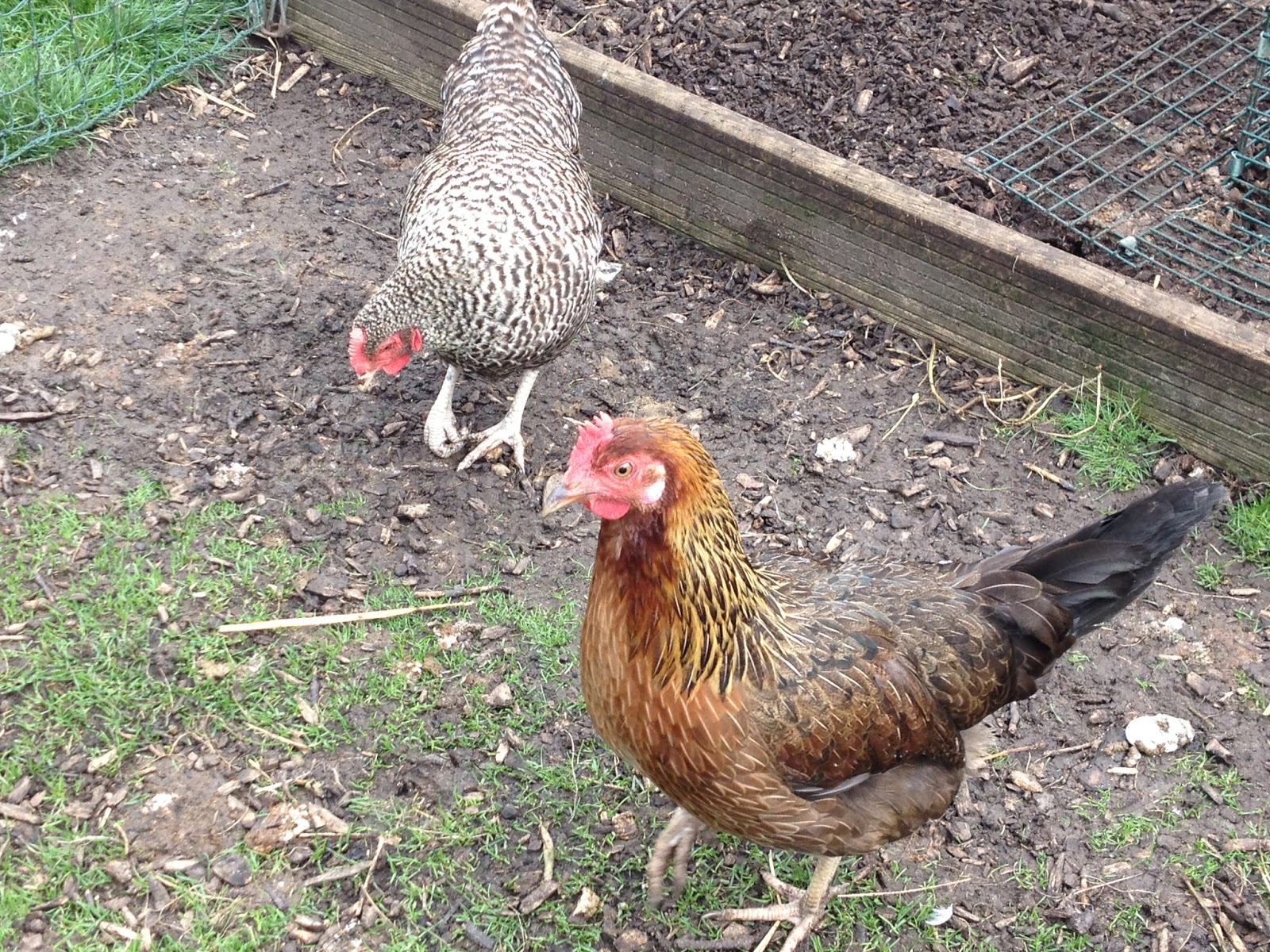
They all have very distinct personalities, and are a range of different hybrid and pure breed hens. Those whose ear patches are white lay white eggs. The others all lay different shades of brown from very pale to a rich brick colour. Their sizes vary a lot too. Mixed use breeds like Rita (a Bluebelle) are very heavy of body and could be killed when young for their meat. Those like Donna (White Star) are bred as laying birds only. There is no muscle (meat) on them at all. It's all feathers and bones.
Rita - Queen of the flock
Penny - 2nd in command (Cromarty behind her)

Xena and Donna
Martha - a bit of a bully

Biscay - very friendly


Hebrides with Fin behind her

Dogger - follows me like a puppy

Fitzroy - very skittish

Cromarty - a real survivor
Viking - big, very dumb, often broody
Finisterre - sweet tempered

Cromarty was a marvel. She was friends with Malin; they were always together. When the fox attacked I found them huddled against each other by the fence. Malin had died and Crom was so terribly wounded. I was scared I'd have to put her down because her damage was so severe. Her wing was broken, her leg injured so she couldn't stand, the back bald with huge bleeding wounds all across it.  We managed to nurse her back to health, although she pined for Malin dreadfully for a week or so. She kept making the little "where are you" peeps hens do when they are lost. 
She is fine now. Fitzroy  and Fin became her new pals. Her feathers are darker than before and she can't jump very high but she's healthy and is laying eggs again. Go Crom!

Questions everyone asks:
1) Do you hatch chicks?
No, we have only females so the eggs are infertile

2) Is that one with the big comb a cockerel? 
(usually Donna, whose comb flops to the side like an oversized quiff)
No, most chickens have combs. The size of the comb is down to the breed and the sexual maturity of the bird

3) How can you get eggs if you haven't got a cockerel?
Hens lay eggs, like women have periods. They happen regardless of the presence of a male.

4) Are you going to eat them when they die/stop laying?
NO! Ew! For a start if they got ill and died I don't want us eating diseased meat. For another thing they have almost no meat on them. And, being old, what little there is of it would be tough as old boots. And hell, I don't eat meat anyway.
But most importantly, these are my pets. They are pets with the benefit of free eggs, but still pets with names and personalities. The cats don't provide me with breakfast* and I don't eat them. And in their post-menopausal years they deserve a happy retirement.

*In fairness, the cats have tried to bring me breakfast on several occasions. It's not their fault I don't fancy mice or sparrow chicks.

Hens are fantastic pets. They eat slugs, weeds, wilted veg we won't eat. They produce the best fertiliser my garden could have. They are easy to take care of, rarely noisy, easy to tame and make the garden a more fun place to be. And when they do lay eggs, those eggs are the most delicious you've ever tasted.
Hurray for chooks!