Showing posts with label seasonality. Show all posts

Saturday, 30 May 2026

Seasonal Food - Asparagus Quiche

 It's the last weekend in May and we're deep into asparagus season. We've passed the first few harvests of a handful of spears and are into the gut. The first cutting I ate while standing next to the saucepan in the kitchen; the next three or four actually made it to the plate. By mid May I had enough tall stalks to make asparagus soup, which is far and away Zach's favourite soup in the world. (I like ALL the soups)

Last weekend, following the mini heat wave, the spears had put on another burst of growth, leaving me with nearly 300g of fresh trimmed asparagus to be used that day. I decided to make a quiche. 

Sublime to ridiculous - the big one was over a metre

It must be said, I never make quiche. Ever. Mostly because it involves pastry and I hate dealing with pastry. It's awful stuff - too cold and it doesn't roll out, too warm and it stretches and sticks to everything. Dreadful. With the exception of making mince pies, I only ever use the ready made pastry, and even then unwillingly.

However, asparagus quiche does look awfully pretty, and heaven knows I've got plenty of eggs from the hens at this time of year. I decided to give it a go.

  • 1 pack of ready rolled shortcrust pastry
  • 4 eggs
  •  140ml milk
  • 80g finely grated hard cheese (cheddar, pecorino, parmesan, whatever you like)
  • as many chopped asparagus spears as you can fit in your dish (about 275g in my case)
  • salt and pepper 
  • grating of nutmeg (optional)

I put the pastry into a lined pie tin and popped it in the freezer while the oven heated to 160 fan. Then I blind baked the pastry for 15 minutes, removed the baking beans and put it back for another 10 minutes.

I whisked the eggs, milk, seasoning and most of the cheese together in a jug. The raw spears were cut into 3cm lengths and the tips set aside. I crammed as much asparagus into the pie tin as possible and poured the egg mix over it until full. I arranged the tips in a circle in the centre of the quiche and sprinkled the remaining cheese on top before sliding it c-a-r-e-f-u-l-l-y into the oven.

It baked in the oven until set which took about 35 minutes, give or take. The time in the oven was just enough to lightly cook the asparagus, still leaving some bite to it, which is my preference. If you prefer asparagus soft, by all means blanch them for a minute or two before baking the quiche.

I'm not going to lie, it was superb. Really, utterly delicious in the way perfectly fresh ingredients just outclass anything you can buy in a shop. The eggs and the asparagus were food metres, not miles, and the asparagus was cut from the veg bed while the pastry was blind baking.

It was far too much for the three of us - obviously Luke wouldn't eat it and Bonnie's still at uni - so I shared some with my Very Excellent Mate Penny. She was also a fan. Asparagus one of those crops, like peas and sweetcorn, which really benefit from being home grown and eaten as soon as you pick them. The sugars start to turn to starch the moment after they're picked so freshness is crucial to the best flavour.

So I guess the real first instructions for this quiche  are:

  1.  Plant your asparagus crowns in February or March. Mulch well
  2. Wait three years 


Monday, 9 October 2023

Beanz Meanz Happiness

One of my very favourite moments in the veg patch is when the borlotti beans are ready to be picked. For weeks I've watched the pods grow and swell, become mottled then a deep satisfying scarlet. They are lovely ornaments dangling down, gently swaying in a breeze. They draw the eye, only to taunt me with Not Yet.

Not quite ready

It's when those pods are drying and dull that the fun starts.

I love the feeling of splitting a leathery pod down its central seam to reveal the cream and purple jewels inside. It's incredibly satisfying. Each bean is a beauty - even the occasional pale green under-ripe ones are pretty. Before long the mound of pods is replaced by a bowl full of plump borlotti beans ready to become that most wonderful of soups - or is that stews? -  pasta e fagioli.


Pasta e fagioli just means pasta and beans. If you're Dean Martin and come from Naples stock*, it's pronounced Pasta Fazool, which conveniently rhymes with "when the stars make you drool," which is why I sing That's Amore every time I make it.

There are probably as many different Correct Recipes as their are Italian families, but this is how I make mine, showing off the borlottis at their finest.

Pasta e fagioli

  • Large bowl of fresh borlotti beans
  • 3 medium onions
  • 2 large carrots
  • 1 small head of celery
  • bay leaves
  • stalk of rosemary
  • sprig of thyme
  • stalks of parsley tied together
  • 2tbs olive oil
  • 2 tins of tomatoes
  • salt
  • pepper
  • lemon juice
then, later, 
  • macaroni
  • water

First, cook the borlotti beans until tender:

In  a good sized pot, tip in the beans and cover with plenty of water. Cut in half one each of the onions and carrots and add them and 4 stalks of celery (including leaves if present) to the pot along with the bay leaves, rosemary and thyme. To make life easier for yourself later, tie the parsley stalks together so you can fish them out easily at the end.

Bring to the boil and skim off any froth, then simmer until the beans are completely tender. This is generally about an hour - do keep checking the beans aren't boiling dry as the liquid will make our soup stock.

Leave to cool, then remove and discard the vegetables and herbs. They have both infused our beans and flavoured the stock, and have little goodness remaining.

Chop up the remaining onions, carrots and celery and fry gently in the olive oil until tender. Add the tinned tomatoes and cook until they've broken down a little.

Depending on which pot is the biggest, either add the beans to the vegetables or the vegetables to the beans and stock. Bring to a boil and season generously with salt and pepper, plus a healthy slosh of lemon juice to brighten the flavours.

At this point, I usually let it all cool and portion it into tupperware or ziplock bags, labelled E Fagioli because they haven't got the pasta in yet. The pasta tends to keep absorbing water and becomes unpleasantly over-floppy if it's kept for several days, in my experience, so is best added when you're going to eat it. I pop the various containers of soup in the fridge and freezer - they defrost just fine, and we have a very quick dinner whenever we need it.

The Pasta bit:

Put as much of the soup in a saucepan as you need for the number of people you are serving. I find a big heaped ladle per person is about right, maybe one and an half if you're greedy me. Add a small handful of dried macaroni per person and some cold water - probably 125ml per portion. Bring the soup to the boil and simmer for around 8 minutes. Top with some grated parmesan or pecorino if you like.

The borlotti beans really are next level delicious. They elevate this from a basic vegetable soup to something rich and nourishing and ridiculously moreish. I highly recomend growing them, they are an absolute doddle.

Buon appetito!


*yes, a terrible soup pun. I'm not proud.

Friday, 8 January 2021

To garden is to be an optimist


It's that rare thing - a properly snowy day in England.  They are exciting days to be relished, as years can go by without them. The wildlife is making the most of it as well - two healthy young foxes were. doing what can only be described as frolicking in the next garden, and it was all very Christmas card-like. Leaping, pouncing, rolling in the snow, looking absolutely gorgeous. The birds are less keen. The hens are quail are hunkered down under shelter. 23 starlings mobbed the bird feeders, so I suspect I'll need to venture out and top that up shortly.

Fox in snow


I'm warm and snug inside with a stack of seed and plant catalogues and a wish list. It's time to plan this year's vegetable garden. 

We've had a lot of reference books over the years but the one I most turn to is the River Cottage Handbook: Veg Patch by Mark Diacono. It's full of practical advice, suggestions about various varieties, soil conditions, sowing and planting charts and all the usual stuff you'd expect. However, what stands it apart is the section on What To Plant.

Diacono suggests first making a list of all the veg you like. Don't worry about whether it will grow or not at this stage, you can whittle the list down later.  If a vegetable doesn't appear on your list, don't grow it.  Sounds obvious but believe me, it isn't. I grew perpetual spinach for several years before accepting that yes, true spinach bolts and runs to seed but who cares? It's far, far nicer to eat than a chard pretending to be spinach. See also beetroot (for my Mum) and radish (for my Dad).

He also suggests you look at several different reasons to plant something. Is it far better when freshly picked? Asparagus, peas, sweetcorn and sprouts picked minutes ago are all a world away from the supermarket equivalent because the sugars degrade to starch by the hour. Freshly picked tomatoes smell absolutely wonderful. The best strawberries you'll ever taste are picked straight from the plant, still warm from the sun.

Large strawberry


Is it expensive to buy but easy to grow? Again, asparagus is the clear example; once the bed is well established it effortlessly produces stalks for years. Herbs grow very well from seed in generous armfuls. The more unusual varieties like Pink Fir Apple spuds are pricey in the shops and a doddle to grow in a sack on the patio.  

The reverse is also important from my point of view - is it cheap to buy and either complicated to grow or needs too much space? Don't bother. (Celery, I'm looking at you.) Greedy things, squashes - the plants grow quickly and well but they take many months and a huge patch of the raised bed to produce something I can pick up for a quid at the supermarket with no loss of flavour. Onions are insanely cheap, whereas shallots are far more expensive to buy and grow beautifully in our climate so I choose them instead.

NB - this space issue is for those of us with limited raised bed space or a small veg patch. You allotmenteers can fill your boots, you lucky devils.

How about thinking about food miles - there are loads of commonly imported vegetables that grow perfectly happily in our gardens. Any we grow ourselves is a step to reducing our carbon footprint. With successional planting in troughs I can keep us in mixed salad leaves from late May to September at the very least. 

Is it attractive? Runner beans were initially grown for their flowers, not the pods, and come in many shades from  white or yellow through orange to the most vivid red. Globe artichokes are stunning plants with huge silver leaves and giant purple thistle flowers (if you leave some buds to develop.) They are always covered in bees and hoverflies. Jerusalem artichokes are really a strain of sunflowers that grow 3m stalks with bright yellow flowers. Borage is not only great for bees and for producing cucumber flavoured flowers for your Pimms, those flowers are prolific and the most heavenly blue. So if you want to enjoy the look of your veg patch as well as its produce, that's worth thinking of.

Diacono also strongly recommends growing something you've never tried before. That's brought me a lot of fun over the years from cute but silly cucamelons, tomatillos for Mexican food, my first taste of quince this year and the ridiculous looking kohlrabi, which makes great coleslaw.  He also suggests something you think you dislike.  I know that sounds contradictory to Grow What You Enjoy, but it's choosing something deliberately to see if your prejudice holds. That's how I learnt that I love sprouts (see Better When Fresh above).

I would add another consideration - Don't Grow What Is Doomed To Fail. Why do it to yourself?  Optimist that I am, I have attempted to grow aubergines on at least 12 occasions. I'm here to tell you that if you live in Yorkshire without a heated greenhouse, my lovely, you are NOT likely to be successful. With red and green peppers you'll get some, with chilli peppers (in a poly tunnel or cold frame) you'll have masses; aubergines? not so much. Ditto rosemary in heavy clay soil, or blueberries planted in lime-rich soil. I also tried chilli peppers from seed unsuccessfully for years until I got a heated propagator. I make that mistake a lot, and it's expensive. Enthusiasm over practicality. I'd save yourself the bother; just look at me as someone who makes mistakes so you don't have to.
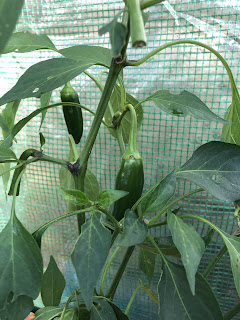
JalapeƱo peppers in a poly tunnel

With all that in mind, I'ver gone through and created the list for Veg Patch 2021. I hope by placing my orders on the early side I won't get blindsided like last year when a third of the things I wanted were out of stock as new lockdown gardeners emptied the shelves. 

This year's wish list include some things I fancy a go at, some things I know we love, some stalwarts we can't do without. I haven’t included shallots, coriander and salad because those are my essentials I won’t forget.

Equally important is my No list. That starts with those I often out of habit but don't justify the space: broccoli and cauliflowers, squashes, more than 2 courgette plants.  The other group includes those that are great  in theory but fail in practice: last year no one harvested the runner beans or peas beyond a handful picked in passing and eaten raw. Not this year, I'll wait until we actually miss them before adding them back in the rotation. (Side eye to Mark, who asked me to plant the runner beans when I don't like them!)

I also know from experience that some plants are more economical for me to buy as seedlings rather than growning from seed myself. I'm an erratic gardener really, and tend to stop paying attention between the exciting bit (Oooh! a seedling!) and the fun bits (big enough to plant out, then later harvesting). Therefore I tend to have more luck with a sturdy couple of cucumber plants than a packet of 10 seeds. It's not all my fault, the slugs are also a major factor, but it's pretty frustrating so now I acknowledge that and work around it. 

By the way, my all time best Buy It, Don't Sow It is sweetpea seedlings from Sarah Raven. They are EXPENSIVE, there's no way around. However, they are extremely study and prolific plants. I get 2-3 bouquets of sweetpeas for at least 12 weeks straight - more if I were a less erratic waterer. It's an annual gift I give myself and it is stupendous value compared to any cut flowers I might buy. The whole house is filled with the scent, it's divine. My friends and neighbours benefit too. She has many gorgeous collections but my favourite are the very simple ones with few flowerheads that produce the most wonderful scent

Sweet peas on the kitchen counter

My final decision on the wish list is to not buy what I will inevitably get given. Last year I was offered courgette and tomato seedlings from 9 different people. Both those good natured plants propagate like billy-o, bless their lovely selves. Any gardener who grows them inevitably ends up with a glut of seedlings and not enough space. I'm going to bank on being offered some*, and will have some less common seedlings to offer in return.

Next jobs - planning what will go where, which involves looking at last year's planting diagram to make sure I'm rotating my crops and remembering companion planting. Then placing the orders. I love this - all the potential, and dreams of warm summer days in my garden, piucking veg for dinner. 

*If this all backfires, don't worry about us going without. I reorganised the freezer and food cupboards this week. Turn out I have 31 tins of tomatoes in there!


Sunday, 5 August 2018

In a pickle

One of the things I missed most when I moved to the UK as a kid was the lack of dill pickles. The lack of good food generally, come to think of it. Sure, the chocolate was better and you get a lovely cup of tea, but the food was almost uniformly lousy, the pizza were appalling and you couldn't even get a nice crisp dill pickle to liven up your sandwich.

The North Wales culinary landscape was pretty miserable in 1985.

Things are much improved. However, I still find the dill pickles a bit hit and miss. Too sweet a lot of the time, or too floppy, or just a bit 'meh'. So I'm making my own.

As I'm not sure how they will turn out, I'm starting with two different recipes.

My new friend-of-a-friend-via-Facebook, the very ace Lisa D, suggested this particular recipe. She's an ex-pat Canadian with excellent taste in many things (i.e. we agree with each other) so that's my first attempt.

Refrigerator pickles aren't proper preserves; they are only good for 2-3 weeks. I'm not sure how many pickles I'll need in that short a time, so I'm only trying one jar for this one. What I have in the cupboard is a much smaller jar than the recipe uses so I've halved the amount of vinegar. I'm using a generous sprig of fresh dill, a peeled clove of garlic (because I like it) and a teaspoon of sea salt. I've sliced the pickles about pound-coin thickness because I prefer them thicker than her wafer thin style.


It takes about 3 minutes to do, and is an absolute doddle.  If these are good I'm going to be delighted.

I liked the idea of longer-lasting pickles too, so I'm doing a more traditional recipe with the majority of jars.

Unlike the massive farms these people seem to have, producing kilo after kilo of cucumbers that require industrial scales of production, I have one plant that escaped the slugs. Downsizing needed.
I swapped the unit of measurement from 1 cup to 1/4 of a cup, and kept proportions the same. so: 1/4 cup table salt, 1 1/4 cups of water, 2 3/4 cups of white wine vinegar, simmered for 10 minutes to dissolve the salt. I put a large sprig of fresh dill, peeled garlic and one fresh chilli pepper (also from the garden) in each jar before stuffing them as full of cucumber as possible.
Because my cucumbers aren't a specific "for pickling" cultivar, they do have more seeds than is usual for dill pickle.  I'm doing some jars with slices and some with spears that I've trimmed the seeds from to see if that keeps them crunchier.
I also read on a number of recipe sites that the blossom end of the cucumber contains enzymes that make it go floppy, so I followed that advice too and trimmed the ends off.

To allow the pickles to last long term, I put all the jars on a folded tea towel in my big stock pot, covered them with boiling water and simmered for 15 minutes. The Internet assures me that will work just as well as a pressurised canner (and obviously the Internet is always factual - ha!) so that's what I did.
Don't worry, I did add more water


When I lifted the jars out (carefully) I could see one wasn't sealed properly so we'll not store that one and eat it soon. The other 4 looked much better, bulging because of the heat, contracting to a vacuum seal as they cooled. They are the duller green I associate with pickles, and I'm very much looking forward to trying them! A shame I have to wait about a month before opening them - I promise I'll update you.

Having been away for 12 days, I had rather a glut of produce to deal with.  I have now washed, trimmed, blanched and frozen over 4kg of French beans, swapped 2 dozen quail eggs for courgette to make fritters, and enjoyed salads of tiny tomatoes with red onion.


I know I say it a lot, but I really do love my garden.


Wednesday, 20 September 2017

Some Diems Need To Be Carpe'd

the fairy-like elegance of the Arctic Tern

Much of the UK tracks the televisual seasons of the year by Strictly, talent shows or celebrities in a jungle. Those aren't really my sort of thing.
I count down the days to Doctor Who, Game of Thrones and, most especially, Springwatch.

Springwatch is one of those creations that is so much a part of BBC's culture it's like the Beeb distilled. It's earnest, a bit geeky, silly, incredibly local and yet also national, and is grounded in a will to educate and inspire. I love the presenters even when they drive me crazy, I love the stories that carry across from year to year (Monty the Osprey! Chris the Cuckoo!) and I especially love how excited it makes me about new species every time.

A while back, Iolo Williams reported from the Farne Islands. As well as the adorable puffins, it was the Arctic Terns that amazed me. They had put a tracker on a tern to see if their estimation of the distances he flew was accurate.  Not a chance - he flew 97,000km in a single year. What a champion.

I wanted to see them myself - what an incredible sight it was, those thousands of birds ad grey seals  coming to stay on these rocky islands. Last year we just didn't have the opportunity. This June, we grabbed a two day gap while Mark was still not working and went north.

The Farnes were everything I'd hoped - stunning, exciting, teeming with wildlife and lit up by warm summer sun.

It was only through help of my ace friends that I could seize the chance to abscond overnight and see this marvellous sight, and I am very grateful.  The trip will stay with me for the rest of my life.


The stacks - more birds nesting than is plausible 

Glossy, gorgeous guillemot and her brood

Arctic terns thought Mark was a well dodgy geezer

keeping a watchful eye for the thieving gulls

every dot is a returning puffin

Razorbills are very handsome

back on the mainland, looking over a beautiful sea

Thursday, 13 October 2016

Thou Shalt Have a Fishy

Gone fishin'

It's a cliche for doing nothing, sloping off, taking it easy.  And it's been an aspiration of mine for a-g-e-s

Number 1 on my list of Things To Do Before I'm 50, fishing for my dinner, was a highlight of my summer.

Thanks to miscalculating how long it takes to get from Teeside to Whitby, and then the total lack of availability of parking spaces Whitby in the summer, my reservation of 4 places on a fishing boat came a cropper.  Luke had obviously opted out as he doesn't eat fish, hates strong smells, and refuses to be involved in the death of animals but I'd booked the rest of us.  As we got more and more frenzied, stuck in traffic with no parking, Mark told me to ditch them and head straight for the boat. Despite the lack of travel sickness pills, Zach agreed to join me.

The day couldn't have been lovelier. It was hot, still and beautiful.  The swell of the tide was pronounced as we were half an hour outside the harbour, but I was fine. This was not the case for everyone.


We fished with just hooks and feathers. Zach was first to reel in two enormous mackerel on his rod, although he was horrified at the prospect of wrenching the fish from the hooks. Sadly, that was it for Zach; seasickness overwhelmed him and he spent the rest of the 3 hours curled up in a ball trying to hold it all together. His good humour whilst feeling wretched was astonishing. He is the most gracious human being I've ever known. "I wouldn't have missed it, Mummy. You were having such a wonderful time that I was happy to be there, no matter how sick I felt. I know how long you've waited to do this."
I wish I could take credit for Zach's aceness but he does it all himself. He's honestly that lovely.

Possibly the nicest human alive, and his mum
I was as happy as it is possible to be when surrounded by slimy fish guts and having not eaten for many hours. That is far happier than I would have expected. The skipper moved us to 4 different sites over the afternoon and we brought up unbelievable quantities of fish.

Mostly I caught mackerel. However, there were whiting, a member of the cod family, and one very small but exciting gurnard.
The skipper yelled, "Don't touch it!" while the rest of the fishing friends leapt backwards.  Gurnard isn't venomous but the spines can deliver a very nasty injury. We removed the gurnard from the hook, threw it back in the sea and it swam off to freedom.
Little gurnard to lived to swim another day

While we paying punters fished and fished, the skipper kindly gutted our catch.  We motored back into Whitby harbour and transferred our fish into great big bin bags.  Zach emerged from his cocoon  of queasy and we joined Mark, Luke and Bonnie on the path.  Being the type to plan ahead, I'd put a styrofoam cooler in the boot. I picked up three bags of ice from the supermarket and tipped it into the cooler with the ice so we could drive the fish home in good condition.

We got home late that night, having detoured to my Very Excellent Mate SJ's house to collect The Great Gonzo, our new kitten.  He's exceptionally naughty and quite spectacularly cute. Sorry, Mark! I can't resist a tabby cat, in whatever colour.

Then Mark cooked a couple of fillets so we could enjoy the very fresh fish.

The next day Mark filleted the many, many fish and I invited friends for a meal. We had potato salad, horseradish dressing, chilli and lime dressing and grilled toasts. It was fantastic sharing food I'd caught. I loved it and so did our friends. I'm delighted than my chance to catch this sustainable and delicious fish resulted in meals for my family and friends.  I couldn't be happier.

Wednesday, 24 June 2015

Jam today

It's the very start of the strawberry season here in Yorkshire. Over the next 3 weeks there will be enough strawberries to satisfy even Miss B, our resident fraisivore. Most of the strawberries aren't quite ripe yet but those that are, are perfect for jam making.


The strawberries from my garden, Strawbopolis, are for snacking purposes only. To be brutally honest, I forgot to water my strawberry plants last year the second the fruiting season ended (I'm a bad, bad plantswoman) and lots of them died. Those that did survive look ace and are producing lots of fruit, which is more than I deserve. Oops.

To pick my strawberries, I went to Kemp's of Horsforth. My friend Jean knew the elder Kemp back in his rugby club days and says he was a dashing blade. Jean's 86, so I guess the Kemp family's farm has been a fixture of North Leeds for a long while. I like getting produce direct from the grower, and even more when it's a local family business. It's much nicer than handing the cash to a supermarket. In addition, PYO means I can be as picky as I like about the fruit; and I am very picky.

Today's haul was a bit disappointing. I was clearly rather too keen and should have left it a week because so few berries were ripe that it took me best part of an hour to pick my 3 kilos. Still, the flavour was good and it's a nice way to while away a morning.
A few ripe strawberries for snacking

Back home, I put on Lily Allen's album Sheezus and set to work hulling the strawberries. My Very Excellent Mate Rachel gave me three Lily Allen albums recently and I love them. When it's a bit of a dead time for radio they are my songs of choice. Rachel also has Cary Elwes's memoir As You Wish for me, which I am very excited about.  Hurray for VEM Rach and her thoughtfulness.

When it comes to jam making  I refer to the mighty Pam The Jam, author of the River Cottage Handbook on Preserves. Pam Corbin's recipes are clear, well explained and almost always work well for me, although I prefer slightly less sugar when I can get away with it. Between cordials, jams, jellies, curds and marmalade I have used her book until it is stiff with sugar spatter and stained with fruit juice. I raise my elderflower martini to her.

Here's my version of what Pam recommends -

Strawberry Jam

2.85kg of hulled strawberries, with any bruises trimmed (3.2kg picked weight)
600g granulated sugar
1.75kg jam sugar
5 large lemons

10-12 clean jam jars with lids

If at all possible, don't wash the strawberries. Wipe any grubby bits off but generally just leave them. Dry strawberries make better jam.
Put the clean jam jars and lids on a lined baking tray and put in the oven. Turn the oven on to 150 degrees and leave the jars in to sterilise.
Stick all the strawberries in a maslin pan or VERY large stock pot. Add the granulated sugar and simmer on a low heat for about 5 minutes until mostly soft.
At this point I let the mix cool before pushing 2/3 of the fruit through a metal sieve with a messy combination of a silicon spatula and my fists. Then I plunge my hands into the jam pan and squish up any lumps of fruit until I have a mostly smooth and partially seed-free mixture.  Pam Corbin doesn't have this step in her recipe because Pam isn't trying to feed fussy family members who don't like pips or fruit pieces in their jam. Lucky, lucky Pam.

NB - By now I look like I've been involved in a massacre. I usually have to swap to a fresh apron at this point or everywhere I lean I make strawberry prints.

Put the jam mixture back on a low heat and add all the jam sugar. This contains the pectin we'll need for the jam to set. I use more jam sugar and less granulated sugar than Pam because overall my sugar-to-fruit ratio is lower - I like a touch of tartness because it tastes more of strawberry that way - so I need the extra pectin to get a good set.
Heat the jam through gently, stirring all the time to ensure the sugar doesn't burn to the bottom of the pan. When it has dissolved completely add the juice of all 5 lemons and turn the heat up. That acidity really lifts the flavour of the strawberries.
Incidentally, cold lemons don't produce as much juice. If your lemons were in the fridge, it's worth popping them in the microwave for about 20-30 seconds before you squeeze them.

Once your jam is boiling away, Pam says it will take 8-9 minutes to reach setting point. Personally, I find it takes closer to 15, but I'm probably doing something wrong.

If you have lots of frothy scum on the top of the jam, pop in a blob of butter and stir the jam until it dissipates. Then it's time to fill the jars, which have been sitting in the oven all sterile and ready to go.
I find it easiest to fill them on the baking tray. It contains any spillage and is easy to clear up.  Put a wide mouthed funnel onto a jar and pour in the jam until full. If you haven't got a jam funnel I find tipping your jam into a glass or earthenware jug with a spout will do as a way to fill the jars with minimum spillage.
Be careful, please. The jam is insanely hot, you do not want any of it splashing on you if you can help it. I got 3 tiny little dots of jam on my knuckles as I was holding the thermometer and they came up as blisters almost immediately.
Put the lids on the filled jars immediately (I use oven gloves or a tea towel) and leave to cool.

I absolutely LOVE the metallic pop the lids make as the jar cools and creates a vacuum.  I find something I "need" to do to make sure I'm in the kitchen for that. It's very satisfying.

Ten jars, two small dishes and a bit for tasting
A note about setting point - You can faff about with drops of jam in cold water or creases on cold saucers but I find my sugar thermometer far more reliable. You can get them from places like Nisbets, and they're well worth having.

Those two little dishes of jam are for my lovely neighbour Wendy, and Jean who knew the Kemps 'way back when.  Sharing a bit of jam will do when the red wine runs out.
All hail kick-ass octogenarian women!

J x

Tuesday, 7 October 2014

Mellow Fruitfulness

Ah, Keats.   Of all the poems I learnt at school, Ode to Autumn is the only one strangers quote t me. There is something about going for a walk and coming across someone picking elderberries or sloes in the hedgerows that seems to compel ramblers of a certain age to say "season of mists and mellow fruitfulness." Every time. Seriously, it happens every single time.

It's a corker of a line, of course. In fact, I like the whole first stanza -

SEASON of mists and mellow fruitfulness,
Close bosom-friend of the maturing sun;
Conspiring with him how to load and bless
With fruit the vines that round the thatch-eaves run;
To bend with apples the moss'd cottage-trees,         5
And fill all fruit with ripeness to the core;
To swell the gourd, and plump the hazel shells
With a sweet kernel; to set budding more,
And still more, later flowers for the bees,
Until they think warm days will never cease;  10
For Summer has o'erbrimm'd their clammy cells.

The apple and pear trees have been wonderful this autumn. I've had crisp, sweet Discovery apples from the cheap little tree from Costco we planted 18 months ago.  There were two freakishly large Red Delicious apples, each as big as a baby's head, from a cordon tree SJ gave us. I can't bring myself to eat them, they're just too ridiculous. Miss B's apple tree has had a less successful year but after last year's bumper crop probably needed the break.

For the first time our little pear tree has been properly productive. Up until this year it's lost most of its fruit before they'd ripened. I've been plucking ripe pears from the branches for a nearly a month - I must have had at least 15, which is good going for such a small tree. They are so much nicer than any pears I've had before, but I suspect that's sentimentalism on my part.

This week my lovely pal Suzanne took me to visit our friends Jo, Ang and Lucy for a visit of walking, sloe picking and a big shared lunch. Lucy is a keen walker and cyclist. When she said there were blackthorn bushes 'near' her house, I hadn't realised she meant a 4.5 mile round trip rather than a gentle stroll along the lane. However, it was a beautiful sunny day, the company was good and the sloes plentiful. It was a lovely day, the kind I will look back on to keep me going during the dark winter days.

People say things like "wait until the after the first frost" to pick sloes, but that's rubbish. Most years, by the time we have a frost the sloes have been eaten by the birds, picked by foragers quicker off the mark, or have wizened on the bush. The frost breaks down the cell structure, which is helpful for making sloe gin. I guess that was pretty useful in times past.

However, we don't live in the 18th century.  We have freezers.  Bobbing your freshly picked sloes in the freezer for a couple of days does a fine job of rupturing the cell structures, with the added bonus of killing off any unwanted passengers.

After picking over the frozen sloes for stalks, leaves or deceased insects,  I poured 1kg of them into a 2 litre Kilner jar. In went just over a litre of gin and 200g of sugar.  Traditional recipes call for a lot more sugar, but I don't like it too syrupy, and I'd rather add more sugar later than end up with something tooth-dissolving.


I've left the jar on the counter this week so I remember to shake it every day. in about a fortnight I'll banish it to the cupboard under the stairs until near Christmas.  Then I'll test the sweetness, adjust as needed, and leave a while longer.

The other autumnal thing I did this weekend was roasting 2 large butternut squashes for soup. I just hack them into big slices or wedges, skin on, and rub a little olive oil across them. Then I bang them in the oven for about an hour.


I pull them out when they are all soft and look like this -


Cooled, rinds removed and whizzed up with stock and pepper, they become pretty much my favourite fall lunch.  That's why I make such a lot at once - I will eat it for days given a chance!

Sunday, 22 June 2014

June in a bottle

One day my daughter will look back on weekends like this with nostalgia. Not a ghastly "geez, I can't believe we did that rubbish," type nostalgia that hits me when I remember watching the Donnie and Marie show. No, proper, Proustian nostalgia when she smells the blossom in her adulthood.
Or at least I hope so.

It was warmer than predicted, the rain showers threatened didn't materialise and the sun beat down as the afternoon progressed. Her eldest brother was dossing in bed after a week of exams, her middle brother was still at a friend's house following a sleepover so Mark and I took her out on her own to the place of her choosing - in this instance, Meanwood Valley Urban Farm. We bought her a sausage roll and crisps; she had a milkshake; she fed donkeys and goats, watched damselflies and ran through the woods to a den. All in all it was a lovely time with the fabulous Miss B.

I noticed the elderflowers all over a massive hedge near the farm's playground. Hurray! We had a lovely time, B and I, picking elderberries in September. Now she could take part in my first foraged harvest of the year, the delicate froth of elderflowers.


We drove out to the lane we'd visited in early autumn. It's easier to pick the flower heads than the berries so we didn't need scissors this time. Mark stayed in the car with the radio while Miss B and I browsed the hedgerows for the cream-coloured, open clusters. We avoided any with a hint of faded blooms as past it, and those with many tight buds as not yet ready.

Partly to let the flowers fulfil their botanic purpose and partly because I love watching the PUFF of tiny pollen specks, we batted each flowerhead before picking it.  Thank heavens neither of us have hay fever.

As we picked and chatted, we were overtaken by a group of walkers.  Clearly not gardeners, they asked us if we were picking blackberries. "No, it's too soon," Miss B confidently told them. "It's elderflowers now." They asked what we'd do with them and how to choose them. Very charmingly, they asked Miss B to help them choose some good flower heads to contribute.  She was delighted to advise.
A fair few flowers ended up in Miss B's hair

In the face of such enthusiasm, we ended up with far more flower heads that I had anticipated. Ah well, I guess we'd better make a LOT of cordial...

Elderflower Cordial

25-30 elderflower heads
1-2 lemons
1/2 to 1 lime
1.5 litres boiling water
900g sugar

Pick over the flower heads to remove any creepy-crawlies. Ideally do this by hand, not washing the flowers before use. However, we'd got 90-odd flower heads so I just filled the sink with cold water and gently swished the flowers about in that, removing any bugs I noticed.
Put the flowers is a large stock pot of maslin pan. Add the zest of the citrus fruit and keep the fruit on one side for juicing tomorrow.  Add 1.5l of boiling water and cover. Leave to infuse overnight.

A whole heap of elderflowers, zest and water
Strain the liquid through a scalded (i.e. covered in boiling water before use to sterilise it) jelly bag or piece of muslin. Add the sugar and the lemon and lime juices. Bring to the boil. Simmer for 5-10 minutes and pour into sterilised bottles.

NB - I was doing a triple batch and lacked sufficient sterilised bottles. I washed some tonic water bottles out in very hot water and filled them with cordial, leaving a 5 inch gap at the top for expansion. When they cooled I popped them in the freezer. They'll keep there until I need them.

Elderflower cordial with soda water and ice is a lovely soft drink. However, it also makes exceedingly lovely cocktails:

Elderflower Martini

1 measure gin
1/2 measure vermouth
1 measure elderflower cordial
Juice of 1/2 a lime

Pour everything into a cocktail shaker with plenty of ice. Shake until frosty and serve.
Chi chin!


Thursday, 30 January 2014

Paddington can have his sandwiches; I have other plans

Hello webby cronies!

January has a lot working against it. It's cold, dark and very rainy. Everyone is on a budget, or on a diet, or in a foul mood thanks to giving up fags, booze, wheat, joy - or all of the above. In our family it's also Miss B's birthday party on top of 2 nieces, my mum, my brother and Z's birthdays so it tends to be a busy and expensive month too.

But there are two bright shining January things that make me happy. The first one is my annual ballet jaunt to London with my Very Excellent Friend Bon, but I've already told you about that in detail.

The other nice thing is something I can share with you - Seville orange season! They are bright, aromatic and wonderful when everything else in season is an all too virtuous-looking dark green: sprouts, kale and so on.


Don't let that marvellous smell fool you, though. Sevilles are dreadfully sour and inedible when raw. They need to be cooked or otherwise processed. The obvious is marmalade, of course, and I had a pleasant afternoon making 8 jars of the stuff.

 Incidentally, I usually have to add a dash of pectin to my marmalade. I do all the recommended stuff like soaking the pips overnight and so on, so in theory I shouldn't need to. I've decided it must be that I use quite a lot less sugar than my recipes call for because Mark and my Dad - the real marmalade lovers in the family - prefer theirs quite sharp. If you are better informed than I on such matters, please to tell me in the comments section.

  Marmalade is all well and good for pleasing partners, fathers and bears visiting from Darkest Peru. What I really want to try this year is orange gin.

There are 20 or 30 recipes easily available through search engines. I went for 70ml of cheap gin, the peel but not pith of 3 to 4 seville oranges, 1 or 2 cloves and 125g caster sugar.
NB  - loads of recipes suggested anything up to 250g of sugar. I prefer my drinks less sweet but if you like sweet liquors, add more.

I have a small serrated knife - a mini bread knife with the rather ludicrous label "breakfast knife" - that I used for getting the peel from the orange whilst leaving all the white pith still on it.  A very sharp knife would do, too, but my veg knives all need sharpening. The oil that makes oranges smell so wonderful is all in that coloured peel. The pith just makes things bitter.

Tip some of the gin into a jug. Pour the sugar in the gin bottle and poke the orange peel and clove in too. Top up the bottle with the gin you put in the jug. Close the lid tightly and shake. Shake it every day or so for a couple of weeks then put it somewhere dark  like the back of a cupboard and forget about it.

By Christmas you will have a lovely orange gin.  I expect it is nice by summer, to be honest, but tradition dictates it steep for the year. Even after a week it looks beautiful, having taken a golden glow from the peel already.

Having made the gin, I had a bunch of pith-covered oranges sitting on my counter. What could I do with then? I can't juice then nor eat them.... Curd! I could make Seville orange curd! It would use up the juice, and as the hens are back in lay I had heaps of fresh eggs to use.

200ml lemon or Seville orange juice
zest of 2 lemons or normal oranges
125g butter
450g sugar
4 large or 5 medium eggs

Making lemon (or orange) curd is a doddle. First you juice your fruit. You need 200ml, so I topped up with the juice of 1 of the normal oranges I was using for the zest as well.
Break all your eggs into a jug and beat them well. Have a sieve to hand.
Put the juice, zest, butter and sugar in a large heatproof bowl. Sit the bowl on a pan of simmering water and stir until the butter has melted and the whole thing looks glossy and smooth. Keep the heat quite low, because if it's too hot the next stage will result in sweet citrus-y scrambled egg. Gently, Bentley, and it's easy as pie.
Pour the beaten egg into the bowl through the sieve - there are little stringy buts that hold the yolk in place and they can go a bit weird in things like curds. Beat the mixture well to combine. Keep stirring over that gentle heat until it is a think and creamy curd. It takes anything from 7 to 15 minutes in my experience. Basically stop once it looks like lemon curd!

Pour it into sterilised jars, seal, and fight with your children about who gets to lick the bowl. (Hint - you do. If they want to lick it, they can do the washing up.)


Supposedly you need to eat it within a month, and store opened jars in the fridge.  Ours never lasts that long.

Ta da! One bag of lovely aromatic oranges turned into 8 jars of marmalade, 2 1/2 bottles of gin and 3 jars of orange curd. Maybe January isn't so bad after all.

J x


Wednesday, 18 December 2013

Festive and Fabulous

Hello webby chums!

My daughter is fashioning the "number of nights until Christmas" out of blu-tack and sticking it next to her bed, the lads are 'just mentioning' how close it is at least twice a day and the tree is dominating the living room so much that we can't see each other on the couches past it. Everyone I meet seems to ask whether I'm ready for Christmas. I guess we're in the final stretch now.

I'm surrounded by presents to wrap, lists of jobs, chaos and pine needles. I don't mind a bit - Christmas may mean a lot of work but it also means Christmas food. Yum.

In my opinion the greatest of all Christmas food* is the mince pie. Some love the cake or pudding, others favour the chocolate oranges and bit tins of sweets. Mark loves the big roast dinner with all the trimmings but I'd be happy with pasta and a salad as long as I had plenty of mince pies.  I think they are worth a little bit of time. Not much in the face of the hours spent shopping, wrapping or writing cards, but more than slinging something into a trolley.

In my first years living here I used to go to a tiny bakery in Hyde Park, now long gone,  that used light pastry and veggie suet. I'd buy them by the half-gross and we'd still run out by Boxing Day. I don't like the stodgy pastry of supermarket mince pies, so I graduated to Jus Rol and a jar of mincemeat to assemble my own.  Then I learnt to make lovely pastry, thanks to a tutor at college.

That pastry left the jar of mincemeat looking outclassed, so I decided to raise my game. Three years ago I made my own mincemeat and BANG! that was it - my prefect mince pie.

I understand making your own mincemeat may sound a little bit mad, but I promise it isn't. We're not heading into Kirsty Allsop lunacy, I promise. It takes me 30 minutes at most to make enough to fill 8 jam jars full. Trust me, it's worth it. It's far nicer, you can tweak the flavours to your own palate and other than peeling and chopping 3 or 4 apples it's almost entirely effortless.

Apples - 2 large cooking apples or 3-4 regular eating apples
400g sultanas
400g raisins
400g mixed dried fruit - I suggest cranberries, cherries, apricots and prunes chopped as needed.
2 oranges
2 lemons
250g vegetarian suet
125g mixed peel
600g brown sugar
1tsp each ground cloves, cinnamon, freshly grated nutmeg

90ml brandy, cointreau or dark rum

Peel and chop the apples and either microwave or simmer in a small pan until softened into a puree. In a very large bowl, chuck all the dried fruit, suet, mixed peel, sugar and spices. Add the zest and juice of the oranges and lemons. Tip in the apple puree and the alcohol of your choice and mix until well combined.
Leave overnight for the flavours to mature. A week or two is even better, a year is also possible - just spoon it onto sterilised jars and seal.

A note on dried fruit -
Don't use currants. Well, do if you feel you must, but I can't recommend it. For my money they add nothing but grittiness to the mixture. Cherries and cranberries add a welcome sharper note, prunes make everything taste richer and more moist, and apricots work really well too.


*Stilton is for life, not just for Christmas. I thought I best clarify that.

Saturday, 9 November 2013

An Apple A Day

Hello webby mates!
My house smells of apples. Our lovely next door neighbours have two big and ancient apple trees in their garden that have reacted to a warm and lovely summer by producing enough fruit to keep the doctor away for a year or five. Unable to use all those apples, they gave great heaping bags of them to me.

I've had a great day this week being a one woman apple processing unit. It could have been a tedious task, peeling and chopping 10 kilos of apples in one sitting, but with a bit of forethought it became a lovely, indulgent day. Seriously, it did. I'm not putting a brave face on it or anything.

The trick is to set up your workstation.  I put a plastic bin - one of those trofast things from IKEA that was holding Duplo until I sold it a fortnight ago - in front of the couch in the living room. I put a large stock pot with water and a slosh of lemon juice on the coffee table. A cutting board, a knife, a peeler and the TV remote and I was good to go.

While I peeled away, the bin neatly catching all the mess and the lemon water stopping the apples turning brown, I watched the first three episodes of The Blacklist. That's an entirely daft series with James Spader clearly having a ball as a charming, immoral master criminal helping the FBI. He is very fun to watch.

Peeling completed, I shoved the trofast tub out of the way and chopped the apples to an accompaniment of Masterchef and The Choir on iPlayer. I think the BBC's iPlayer is God's gift to the modern age.

I took my chopped apples into the kitchen, popped on 6Music on the radio and got to the fun bit - cooking!

I washed some empty jars and popped them in the oven at 150 degrees to sterilise while I made a compote of apples with brown sugar and cinnamon and a huge vat of applesauce.

I'd like to give you a recipe but in all truthfulness there isn't one - the apples can vary so much in sweetness that giving amounts is pretty meaningless. I plopped a saucepan full of apples and a splash of water on the hob, tipped in a cup of brown sugar, a couple of strips of lemon zest and a cinnamon stick. I stirred frequently until it was all cooked. I tasted it, added a dash more sugar and removed the cinnamon and lemon peel, cooked it through for another 2 minutes and it was done.

The applesauce was the same but larger quantities - a stock pot full of apple, a splash of water, a generous couple of handfuls of caster sugar and stir well until cooked. Add more sugar to taste as you go. I like my spiced compote rather sharp and my applesauce sweet, but it is entirely personal preference. Just taste it as it cooks and remember it's easy to add more sugar but a bit of a bugger to try and remove it.

I ought to mention that applesauce or compote does not keep like jam. It's the high sugar content of jam that preserves it for so long. Applesauce has a mere fraction of that. I keep it in the fridge because I know I use it up pretty quickly (I can eat it by the bowlful. It reminds me of being a kid and Canada.) If you are not likely to be using it in the next couple of weeks I recommend freezing it in zip lock bags. It can keep for ages then.

Once the sauce and compote were bottled up I turned the oven up to 180 and made four of Riet's Dutch Apple Cake. I posted the recipe here in 2009, and these days I do make it in loaf tins after all. I can fit four of them in the oven at a time so I'm making maximum use of 1 hour of the oven being on, and the cake freezes well. So, one cake to the neighbours to thank them for the apples and the others popped away for later.

By this point I decided I needed some different entertainment. I swapped to my ipod and sang along to Tom Petty. The wonderful Tom is my go-to guy for songs to work to. I have decorated whole rooms to Full Moon Fever. It is one of my favourite albums in the world. I tend to favour stuff I can sing along with other music. It's just more fun. Although not necessarily for anyone within earshot.

As a treat for my lovely 11 year old I used some of the compote in lieu of jam to make Jam Jacks, our name for Mary-Anne Boerman's Crunchy Oat Slices. I find them a bit too prone to falling apart but that could be me not doing them quite as intended. However fragile they end up, they are definitely delicious.

Of course you can't bake with masses of apples without doing a crumble. It's probably a Law. Ever the law-abiding citizen, I made three - one for the freezer for my parents, one for the neighbour on the other side of our house and one for us.

My New Favourite Thing for apple crumble is to chuck a few fistfuls of pecans in the crumble mix. Apples and pecans are such happy bedfellows. The flavours round each other out, adding a depth and fullness lacking when it's just one or the other. I often experience tastes like they were music, and a good combination is like a wonderful chord as opposed to an individual note. Pecans and apples are a lovely chord.

NB - Other people do that too, right? I assume they do but perhaps they don't. It's like being unhappy in an orange room because it is yelling at you or knowing which numbers are friendly (the seven times tables definitely are, the sixes less so). Everyone is a little bit synaesthetic, aren't they?

My final effort - to The Leisure Society's marvellous album The Sleeper - was to start another batch of bramble jelly. This is 1 kilo of blackberries (from the freezer, as swapped for eggs with another neighbour in September), 1 kilo of apples roughly chopped but not peeled nor cored, an a little over a litre of water. I simmered them all together until they were a total mush ready for straining then boiling up with sugar. I do love the rich purple colour, and how the stained apple chunks look like watermelons with their vivid flesh and green skin.

Anyway, at the end of my own personal Apple Day I had 4 jars of compote, 2 massive ones of applesauce, 4 cakes, 3 crumbles, a tray of slices and a vat of jelly-in-progress.  I'd watched daft telly, listened to the radio, sung lustily along with some favourites and made the house smell utterly delicious.
All in all, a very good day.


Sunday, 22 September 2013

Entente Cordial

Hello webby world!

Sometimes a bit of seasonal goodness can fix pretty much anything. Like this:
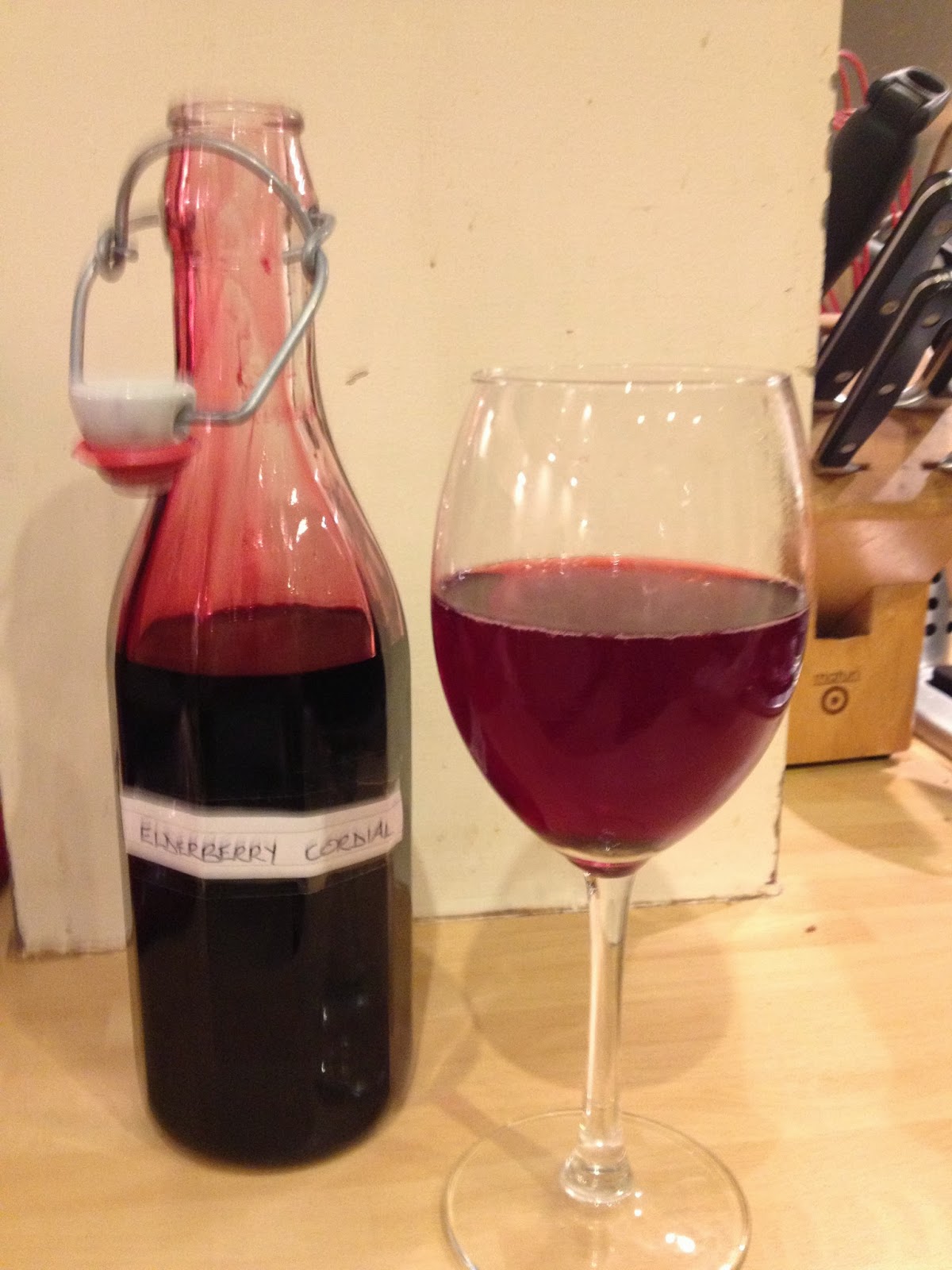
Are you well?
 No? Oh, poor thing, you sound full of a cold. Have a spoon of elderberry cordial to help your cough.
Yes? Marvellous! Join me in a cocktail. I've made Hedgerow Kir Royale: elderberry cordial and prosecco.

Droopy, juicy elderberries
If you need neither soothing nor plying with exciting purple cocktails (is that possible?), how about having some on greek yogurt or stirred through your porridge. It's full of vitamin C and is supposed to be good for colds and flu.
I don't actually care about that if I'm truthful. I only care that it is utterly delicious.
And seasonal, which is oh so virtuous and fashionable these days.
And mostly free, making it ideal for these frugal and glum times. (Except when you add prosecco to it.)
And I get to make it myself, continuing my transformation from lazy bookworm to the Ambridge matriarch.*

*A side note: My mum and I have been emailing back and forth with competing baking and preserve making triumphs over the last week. I sign mine Jill Archer Wannabe, Mum signs hers Suzy Homemaker. Suzy overtook Jill when she made 90 billion jars of damson jam (well, 34. but that's pretty much a billion ) over the past two days. However, I'm not writing Jill off yet - I have more types of jam, jelly, crumble and cordials. Plus I'm hoping the 220 shortbread biscuits I made today will help pull Jill into the lead.

In case you too would like to make the miracle of scrumptiousness that is elderberry cordial, here's how I did it.

First, pick your elderberries. Assuming you aren't in a totally concrete environment, you'll find heaps of them around just now. We drove to the hedgerows a few miles from our house, near Harewood, because there are absolutely MASSES there. I prefer to use a little pair of scissors to pick the berries to just pulling them because fewer berries fall to the ground. Only pick the droopy, heavy berry clusters - they are the most ripe and juicy.
When you've filled your carrier bag, head home for the exciting task of removing the berries from the stalks. This is important because the plant and unripe berries contain a form of cyanide. (Don't get too worried, so do loads of fruit we eat. It's mild) The ripe ones are good for you once they've been cooked, which breaks down the alkaloids that cause the problems. Well, the BBC Food website says that and if you can't trust the BBC who can you trust?

Anyway, removing the berries by hand is a long and finger-staining job. I use a fork to whip them off the stalks much more quickly. It still took me an hour but I had the radio to keep me company.
I pick out any green, unripe berries by hand. I also have to keep an eye out for unwitting passengers. This week's score was:
          Earwigs:   1
         Ladybirds: 4
         Spiders: 17
Despite using a fork mostly, I still ended up with fairly stained hands, but it washed off far more easily than the stains from the plum jam.
Note the very short nails. Between baking, gardening and jam making I think the shorter my nails are the better. 
Anyway, I ended up with two and a half kilos of elderberries. Most I simmered with apples to make elderberry jelly but some were for the cordial.

I add about 400 or 500ml of water per kilo of elderberries and simmer them for around 25 minutes. I bash them about with a potato masher towards the end of the cooking period to release as much juice as possible. It goes an astonishingly rich dark purple colour.  Then it is ready to be strained.

Straining it needs a jelly bag, a fine tea towel or some muslin suspended above a bowl. I use a jelly bag tied to the legs of an upturned kitchen chair that I sit on a counter out of the way, with a LARGE bowl underneath the bag to catch the liquid. You need to let gravity do its work, slowly trickling and dripping all the juice out. If you squeeze the bag or press the berry pulp to speed things along your cordial (or jelly) will be cloudy.My advice it to go see a movie at this point. Or take a nap. Naps are lovely.

When I was ready to crack on (i.e. woke up) I popped some clean bottles in a low oven to sterilise. Lakeland and other places do nice bottles with swing tops that are really good for this sort of thing if you want to give the cordial as a present. 
I added 400g of sugar per litre of elderberry liquid and heated it in a saucepan. Once the sugar had dissolved I tasted it for sweetness and added any more I felt necessary (not much on this occasion.)  I poured the cordial into the warm sterilised bottles and sealed them. All done.

Recipe - Hedgerow Kir Royale

Add one tablespoon of elderberry cordial to each wine glass and top up carefully with Cava, Prosecco or whatever sparkling wine you like. It froths hugely, so go easy.
Share with your very best pals.
Cheers!
Iechyd Da!